
December 30, 2025

“Mullahs Must Leave”: Iran Erupts as Economic Collapse Fuels Political Rage — Is There a Trump Factor?

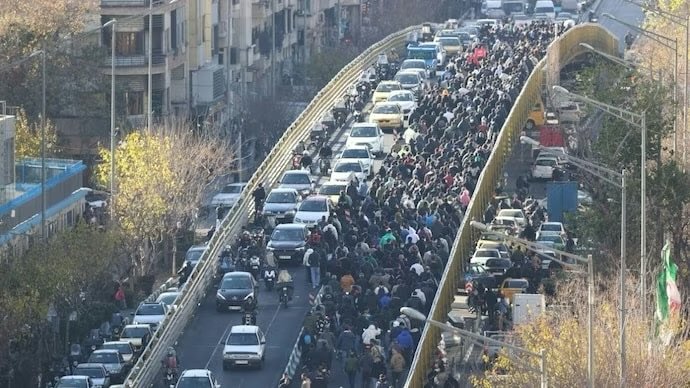
Iran is once again on the brink. Over the past two days, widespread protests have erupted across major Iranian cities, marking the largest wave of unrest the country has seen in nearly three years. Streets echoed with chants of “mullahs must leave” and “death to the dictator” as protesters confronted security forces loyal to Supreme Leader Ayatollah Ali Khamenei and the ruling clerical establishment. This time, the anger is raw, coordinated, and unmistakably political. An Economy in Freefall At the heart of the unrest lies a collapsing economy that has pushed ordinary Iranians to the edge. The Iranian rial has plunged past 42,000 to the US dollar, wiping out savings and making daily survival increasingly difficult. Inflation has surged beyond 42%, driving up food prices, fuel costs, and basic necessities. For many households, wages no longer last beyond a few days. Years of international sanctions, compounded by structural mismanagement and corruption, have hollowed out the economy. The middle class has shrunk dramatically, while unemployment and underemployment among youth continue to rise. This economic pain has now spilled onto the streets — and it is no longer being framed as a temporary hardship, but as a systemic failure of the Islamic Republic itself. From Economic Anger to Political Defiance Unlike earlier protests that focused narrowly on prices or subsidies, the current unrest has crossed a clear line. Slogans no longer target individual policies; they directly challenge the legitimacy of clerical rule. Protesters are openly rejecting the authority of religious leaders, calling for an end to the theocratic system that has governed Iran since 1979. Videos circulating from multiple cities show crowds chanting in unison, defying fear despite the presence of armed security forces. Iranian-American journalist Masih Alinejad described the scenes as the voice of a population that “does not want the Islamic Republic.” The message is blunt: economic collapse has exposed political exhaustion. The Trump Pressure Question The timing of the protests has reignited debate over the role of renewed American pressure under US President Donald Trump. Trump’s return to the White House has brought a sharper, more confrontational approach toward Tehran. Sanctions enforcement has intensified, financial channels have tightened, and diplomatic engagement has been replaced by pressure tactics. While the protests are not externally orchestrated, the economic consequences of renewed sanctions are undeniable. The rial’s collapse and inflation spike have accelerated since the tightening of US measures, amplifying public frustration. However, to frame the unrest purely through a “Trump angle” would be misleading. The protests are homegrown. They are the result of decades of economic mismanagement, political repression, and a leadership structure unwilling to reform. External pressure may act as a catalyst, but the fuel is entirely domestic. The Regime’s Familiar Response The Iranian state has responded in predictable fashion. Security forces have moved swiftly to disperse crowds, block streets, and restrict movement. Internet disruptions and communication slowdowns have been reported, a familiar tactic aimed at preventing coordination and limiting the spread of images. State media has largely downplayed the scale of the protests, framing them as isolated incidents or blaming “foreign agitation.” Yet the geographic spread and intensity suggest something deeper — a crisis of confidence within the system. The regime has survived such moments before, but each cycle leaves it weaker, more dependent on force, and further disconnected from society. A Tipping Point or Another Suppressed Uprising? Iran has witnessed repeated waves of protest over the past decade — in 2009, 2017, 2019, and 2022. Each time, the state managed to suppress dissent without offering meaningful reform. What makes this moment different is the convergence of factors: Severe economic collapse Open rejection of clerical authority A population increasingly unafraid to name the system as the problem Whether this unrest becomes a sustained movement or is once again crushed remains uncertain. What is clear is that the social contract between the Iranian state and its people is badly fractured. The Bigger Picture These protests are not simply about inflation or currency rates. They are about dignity, representation, and exhaustion. For many Iranians, the question is no longer “Can the system be fixed?” but “Why should it continue at all?” As chants of “mullahs must leave” echo through Iranian streets, the message is unmistakable: economic pain has transformed into political rebellion. External pressure may shape the environment, but the uprising itself is a mirror held up to decades of unaddressed internal failure. The world may debate geopolitics. On the streets of Iran, the debate is about survival — and the future.
“Mullahs Must Leave”: Iran Erupts as Economic Collapse Fuels Political Rage — Is There a Trump Factor? Read More »

Begum Khaleda Zia (1946–2025): The Woman Who Defined an Era of Bangladeshi Politics

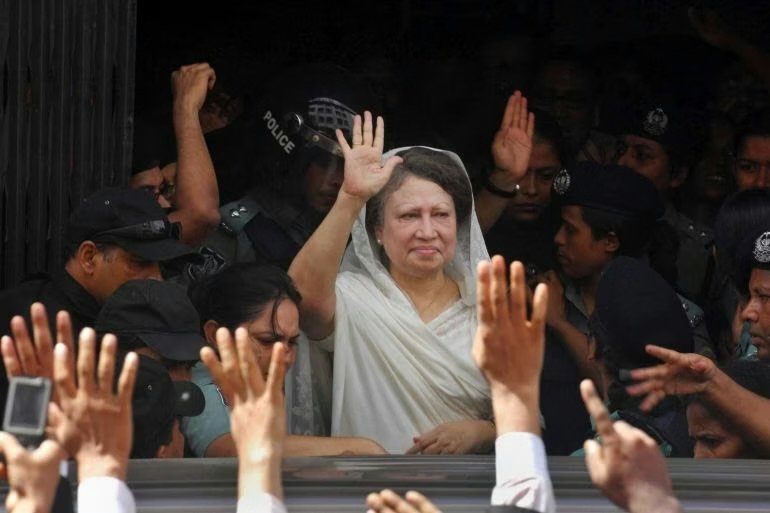
In early December, a lone figure stood outside Evercare Hospital in Dhaka holding a handwritten placard: “I want to donate my kidney to Begum Khaleda Zia.” The man, Tipu Sultan, a 48-year-old grassroots activist of the Bangladesh Nationalist Party (BNP), refused to leave the pavement opposite the hospital gate. He said he would stay there until he heard news of her recovery. For Tipu, Khaleda Zia was not just a political leader. She symbolised sacrifice, resilience, and the struggle for civilian rule in a country long shaped by military interventions and street politics. His quiet vigil reflected a larger national mood — anxious, emotional, and deeply divided — as Bangladesh watched the declining health of one of its most influential leaders. That vigil ended at dawn on December 30. Khaleda Zia passed away at the age of 79. With her death, Bangladesh did not simply lose a former prime minister. It closed a political chapter that had dominated the country’s public life for more than three decades. The End of a Political Duopoly For over thirty years, Bangladeshi politics revolved around two towering figures: Begum Khaleda Zia and Sheikh Hasina. Their rivalry shaped elections, governance, protests, and even the language of political debate. Supporters defined loyalty through them; critics measured instability through their confrontations. Now, with Sheikh Hasina living in exile and Khaleda Zia gone, that era has ended. Both women rose claiming the mantle of democracy and resistance to authoritarianism. Both inspired intense loyalty and deep suspicion. And both left behind legacies that are complex, contested, and impossible to reduce to simple moral verdicts. Early Life: Before Politics Chose Her Begum Khaleda Zia was born on August 15, 1946, in Dinajpur, then part of East Bengal under British rule. Her family background was rooted in business rather than politics. Her father, Iskandar Majumder, had previously run a tea business before relocating permanently to East Bengal following the 1947 partition. She grew up in Dinajpur, studied at Dinajpur Government Girls’ High School, and later attended Surendranath College. By all accounts, she lived a private life and showed little inclination toward public office in her early years. Politics did not attract her. Tragedy pushed her into it. A Widow Thrust Into Power On May 30, 1981, her husband, President Ziaur Rahman, was assassinated during a failed military mutiny in Chattogram. His death plunged Bangladesh into uncertainty and left the party he founded leaderless. At the time, Khaleda Zia had no political career of her own. Yet senior party figures believed she was the only person capable of unifying the fractured organisation and preserving Ziaur Rahman’s legacy. What began as symbolic leadership soon turned into real authority. The context was hostile. In March 1982, the military seized power again, imposing martial law and shrinking political space. Khaleda formally joined the BNP in January 1982, rose to vice chairperson in 1983, and became party chairperson in 1984. Her political identity was forged in confrontation — against military rule and later against rival civilian governments. Power, Elections, and Polarisation Khaleda Zia went on to win three national elections and serve multiple terms as prime minister. Her time in office coincided with the return of competitive politics, economic liberalisation, and the expansion of private media. Yet her leadership style was uncompromising. When out of power, she frequently rejected electoral processes she considered illegitimate, leading boycotts and prolonged street movements. Supporters viewed this as principled resistance; critics saw it as obstruction that weakened democratic institutions. Allegations of corruption followed her governments persistently. Although courts later convicted her in cases brought during a rival administration’s rule, her party maintained that the charges were politically motivated. These controversies ensured she remained a polarising figure — admired by followers, distrusted by opponents. Personal Loss and Political Isolation Behind the public battles, Khaleda Zia endured repeated personal losses. Her elder son, Tarique Rahman, was arrested during a military-backed caretaker government’s anti-corruption drive in 2008 and spent years in exile. Her younger son, Arafat Rahman Koko, died of cardiac arrest in 2015 while living abroad. In 2018, Khaleda herself was imprisoned following corruption convictions. Years of confinement, isolation, and declining health gradually removed her from active politics. Even after her release on medical grounds, she remained largely confined to her home and later to hospital rooms. Only days before her death did a symbolic shift occur, when her elder son returned to Dhaka after legal cases against him were dropped by an interim administration, briefly raising hopes among supporters that she might witness a political revival. She did not. A Legacy Without Easy Answers Begum Khaleda Zia’s life resists clean judgement. She was neither a flawless democrat nor a simple authoritarian. She was a leader shaped by loss, hardened by political combat, and sustained by extraordinary loyalty from her supporters. To many, she embodied endurance — a woman who faced prison, exile of her children, and relentless pressure without abandoning her claim to political relevance. To others, she represented a confrontational style of politics that deepened national divisions. Both views coexist. What remains undeniable is her impact. For more than three decades, Bangladesh’s political rhythm moved to the cadence of her rivalry, resistance, and resilience. Outside Evercare Hospital, Tipu Sultan eventually folded his placard and walked away. The vigil ended. An era ended with it.

Begum Khaleda Zia (1946–2025): The Woman Who Defined an Era of Bangladeshi Politics Read More »

Skyward Specialty Partners with Sixfold to Advance AI-Powered Underwriting

Skyward Specialty Insurance Group, a specialty property and casualty insurer focused on complex and niche risks, has partnered with Sixfold to accelerate the adoption of AI-powered underwriting across its domestic P&C portfolio. The partnership is part of Skyward Specialty’s ongoing effort to strengthen underwriting performance through data-driven insights, greater efficiency, and faster decision-making, while keeping human judgment at the center of the process. The insurer underwrites across multiple specialty P&C lines and works closely with broker partners to deliver tailored insurance solutions. Sixfold offers an AI underwriting platform designed to streamline insurance workflows by pre-processing submissions and generating structured recommendations. These include risk summaries, appetite alignment, and prioritisation, enabling underwriters to evaluate submissions more quickly and consistently. Under the partnership, Sixfold’s platform has been rolled out across six Skyward Specialty business units and more than 10 product lines. Average deployment timelines of eight to ten weeks have allowed the insurer to rapidly scale the technology across its operations. Andrew Robinson, Chairman and CEO of Skyward Specialty, said the collaboration builds on years of investment in AI-enabled underwriting. He noted that the focus remains on empowering underwriters with stronger insights, faster access to information, and more time to focus on high-value decision-making and service to broker partners. Robinson added that the platform enhances insight, consistency, and speed of analysis, while creating a continuous learning loop that improves outcomes over time. He described the initiative as disciplined innovation that supports long-term outperformance and strengthens the company’s early-mover advantage in the increasingly competitive AI underwriting landscape. The partnership highlights Skyward Specialty’s commitment to maintaining a leadership position in the use of advanced technology to serve the specialty insurance market.

Skyward Specialty Partners with Sixfold to Advance AI-Powered Underwriting Read More »

© MY CIRCLE STORY

Scroll to Top